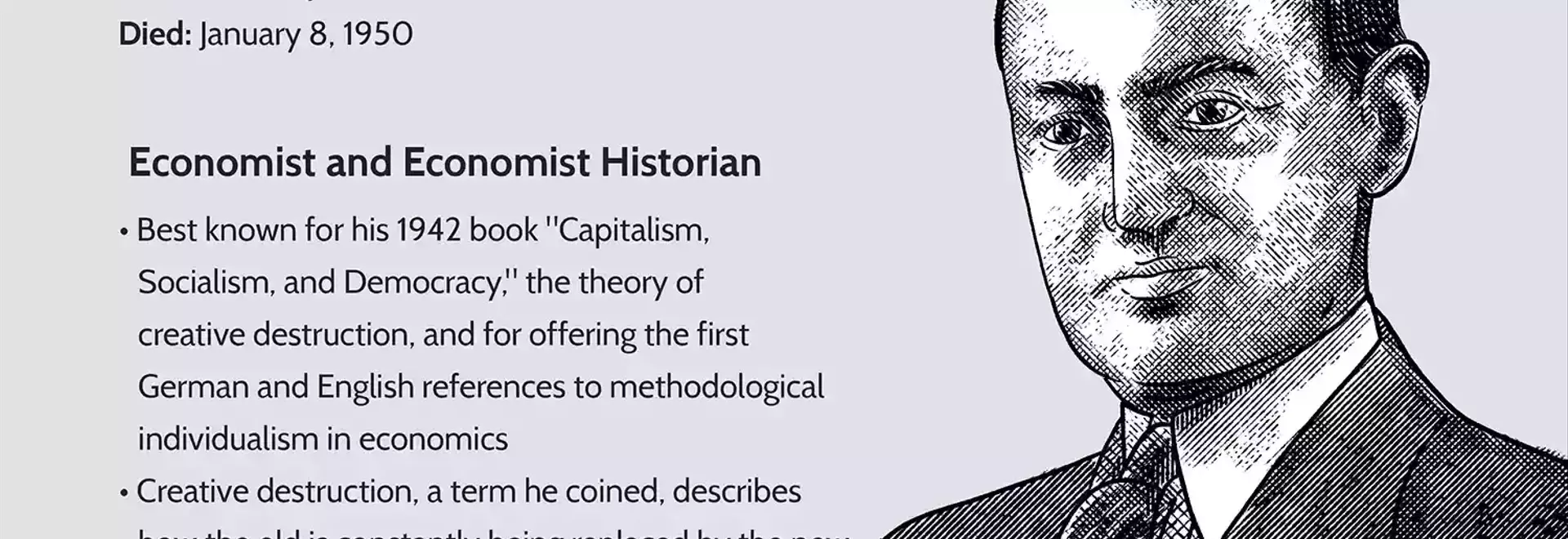
Joseph Schumpeter's Economic Theories: Innovation, Creative Destruction, and Entrepreneurship
Joseph Schumpeter, a prominent 20th-century economist, significantly contributed to economic thought through his theories on business cycles, capitalism, and the critical function of innovation. His most recognized concept, "creative destruction," describes the inherent dynamism of capitalism where new innovations continuously dismantle older systems to pave the way for progress. Schumpeter's work also underscored the central role of entrepreneurs in driving economic transformation.
Born in Moravia (now the Czech Republic) in 1883 to German parents, Schumpeter received his economic education from leading figures of the Austrian school, including Friedrich von Wieser and Eugen von Bohm-Bawerk. His diverse career included serving as Austria's finance minister, a bank president, and a university professor. He taught at the University of Bonn from 1925 to 1932. Faced with the rise of the Nazi Party, he relocated to the United States in 1932 to join the faculty at Harvard University. In 1947, he achieved the distinction of being the first immigrant elected president of the American Economic Association.
In the early 20th century, economic discourse in the U.S. and Britain largely focused on static, mathematically driven equilibrium models. Schumpeter's approach often diverged from this, reflecting a more nuanced and less hypothetical Continental European tradition. While he drew some theoretical inspiration from Walrasian general equilibrium, his emphasis on dynamic processes set him apart.
Schumpeter's most enduring contribution is found in his 1942 book, "Capitalism, Socialism, and Democracy," particularly in the chapter on "creative destruction." This theory challenged the conventional notion that markets naturally gravitate towards equilibrium until profits dissipate. Instead, Schumpeter argued that economic progress is frequently discontinuous and disruptive. He used the term "creative destruction" to characterize the process of dismantling established practices, technologies, and products to introduce novel ones. He famously stated, "This process of creative destruction is the essential fact about capitalism.”
Within this dynamic framework, Schumpeter viewed the entrepreneur as a revolutionary force, constantly challenging the status quo and driving innovation. He is widely credited with introducing the concept of entrepreneurship and its economic significance, coining the German term "Unternehmergeist" (entrepreneur-spirit). These entrepreneurial innovators, by introducing new products and technologies, continuously disrupt existing equilibria, leading to higher standards of living.
Schumpeter's theories extended to business cycles, which he believed were characterized by long and short waves. Major technological advancements and the emergence of new industries, occurring every 50 to 100 years, initiate long waves. He argued that the temporary losses experienced by existing businesses and workers during these cycles are tolerable, as they allow resources to be reallocated to more productive uses. The internet serves as a prime example of Schumpeterian creative destruction, as it rendered many traditional products and methods obsolete, creating new industries and transforming economic landscapes.
Schumpeter's views often contrasted sharply with those of his contemporaries, most notably John Maynard Keynes. While Keynes emphasized static equilibrium as a sign of economic health, Schumpeter saw it as stagnation, advocating for innovation as the true economic driver. Their differing perspectives also extended to government intervention, with Keynes supporting central bank policies to achieve stable prosperity, while Schumpeter warned that government intervention could lead to inflation and economic instability.
Schumpeter's intellectual legacy is profound. His concept of creative destruction provides a fundamental understanding of how economies evolve, particularly within a capitalist system. His emphasis on entrepreneurship and innovation continues to influence modern economic models, offering insights into competition, firm dynamics, and resource reallocation. His work, initially overshadowed, has emerged as a cornerstone of contemporary economic thought, providing a dynamic lens through which to view economic progress and transformation.