Understanding Leveraged Loans: Structure, Applications, and Risks
Finance

Understanding Leveraged Loans: Structure, Applications, and Risks

authorBy Fareed Zakaria
DateApr 23, 2026
Read Time2 min

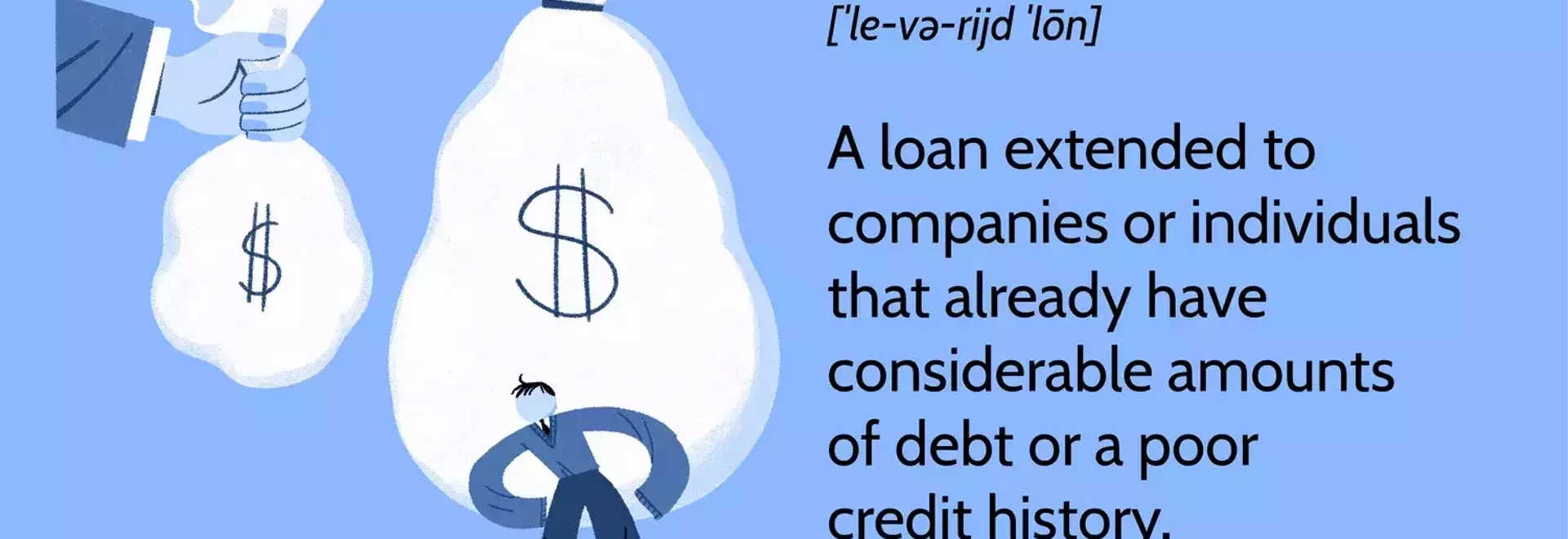
Leveraged loans are a specific type of financial instrument extended to businesses or individuals who already carry a substantial amount of debt or possess a less-than-stellar credit history. Due to the elevated risk of default associated with such borrowers, these loans inherently command higher interest rates. Financial institutions, typically commercial or investment banks, play a crucial role in structuring and administering these loans, often subsequently distributing them to a wider pool of investors through a syndication process to mitigate their own exposure to risk. This mechanism allows for the distribution of financial burden and opportunity across multiple parties.

The classification of a loan as 'leveraged' isn't governed by rigid, universal criteria, but rather by general market practices and regulatory interpretations. One common indicator is the loan's interest rate, which is frequently structured as a floating rate. This rate is usually tied to a benchmark such as the Secured Overnight Financing Rate (SOFR), supplemented by an additional margin, often referred to as an ARM margin. If this margin exceeds a certain threshold, the loan is typically deemed leveraged. Another key determinant is the borrower's credit rating; loans assigned ratings below investment grade by major agencies like Moody's (Ba3 or lower) or S&P Global Ratings (BB- or lower) are generally considered leveraged. Companies strategically employ these loans for various purposes, including financing mergers and acquisitions (M&A), orchestrating leveraged buyouts (LBOs)—where a company goes private with significant debt—recapitalizing their balance sheets, or simply for general operational expenditures.

In essence, leveraged loans represent a segment of the credit market offering higher yields to investors willing to accept increased risk. While these loans provide crucial funding avenues for indebted entities or those with lower credit standing, their complex structure and inherent risks necessitate careful consideration. For both lenders and borrowers, a comprehensive understanding of the mechanics, applications, and potential pitfalls of leveraged loans is paramount for informed decision-making in the dynamic financial landscape. The ability to manage and adapt to fluctuating interest rates and credit market demands is key to navigating this specialized financial product successfully.

More Articles
Finance
Invesco AI and Next Gen Software ETF: Seizing the Future of AI Innovation
The Invesco AI and Next Gen Software ETF (IGPT) is poised for robust growth, leveraging the accelerating adoption of AI and advancements in next-generation software. This ETF strategically invests in platforms and technologies vital for AI development, with key holdings including industry giants such as Alphabet, Broadcom, Intel, and Micron. Projected capital deployments of $700 billion in 2026 and $820 billion in 2027 are expected to fuel significant expansion across semiconductors, data centers, and critical infrastructure. Despite promising prospects, potential risks encompass slowdowns in data center growth and AI adoption, alongside vulnerabilities to global supply chain and geopolitical disruptions affecting essential materials.
By Michele FerreroApr 23, 2026
Finance
Understanding Disruptive Innovation: Reshaping Industries and Markets
Disruptive innovation is a powerful force that reshapes markets by transforming complex, high-end products into affordable, accessible solutions for a wider audience. This approach challenges established industries by introducing new business models, often driven by enabling technologies. Companies like Amazon and Netflix exemplify this phenomenon, demonstrating how new entrants can redefine market standards and displace entrenched leaders. This article explores the core principles, key components, and illustrative examples of disruptive innovation, distinguishing it from sustaining innovation and highlighting its transformative impact on various sectors.
By Lisa JingApr 23, 2026
Finance
Toast: A High-Growth Specialist With AI Tailwinds
Toast presents a compelling investment opportunity within the mid-cap growth sector. Despite market concerns surrounding payments, consumer spending, and enterprise software, the company's 2025 metrics project significant growth in location count, revenue, and Annual Recurring Revenue (ARR). Its integration of AI, expansion into enterprise markets, and focus on high-margin software/fintech services are fortifying its competitive advantage and long-term financial prospects. Trading at 2.3 times forward revenue, Toast's current valuation appears to undervalue its continuous scaling, innovation, and market share capture.
By Morgan HouselApr 23, 2026
Finance
The Dynamic World of Interactive Media: Transforming Engagement and Experience
Interactive media refers to dynamic digital platforms that allow users to actively engage with and influence content, rather than passively consume it. Spanning social media, video games, apps, and virtual reality, it fosters communication, collaboration, and personalized experiences. Fueled by technological advancements like the internet and smartphones, interactive media has become integral to modern personal and professional life, with artificial intelligence poised to drive its next evolution.
By Suze OrmanApr 23, 2026
Finance
Understanding RevPAR: Key Metric for Hotel Performance Evaluation
RevPAR, or Revenue Per Available Room, is a critical performance indicator in the hospitality industry. It assesses a hotel's capacity to fill its rooms at average rates and helps guide pricing and occupancy decisions. This metric aids hoteliers in comparing their performance against industry benchmarks and making informed decisions to maximize revenue. The article delves into its calculation methods, strategies for improvement, and alternative metrics that provide a more holistic view of hotel financial health.
By Robert KiyosakiApr 23, 2026