U.S. Metro Areas See Sharp Decline in Immigration Rates
News

U.S. Metro Areas See Sharp Decline in Immigration Rates

authorBy Michele Norris
DateMar 26, 2026
Read Time2 min

A recent analysis by the Census Bureau indicates a marked downturn in immigration across all U.S. metropolitan regions during the period concluding in July 2025. This trend, characterized by substantial reductions in net immigration rates, has had a profound impact on population dynamics, particularly in border communities and major urban hubs, where growth has either decelerated significantly or turned negative. The findings suggest a widespread shift in demographic patterns throughout the country, with three-quarters of all counties experiencing diminished or reversed population increases.

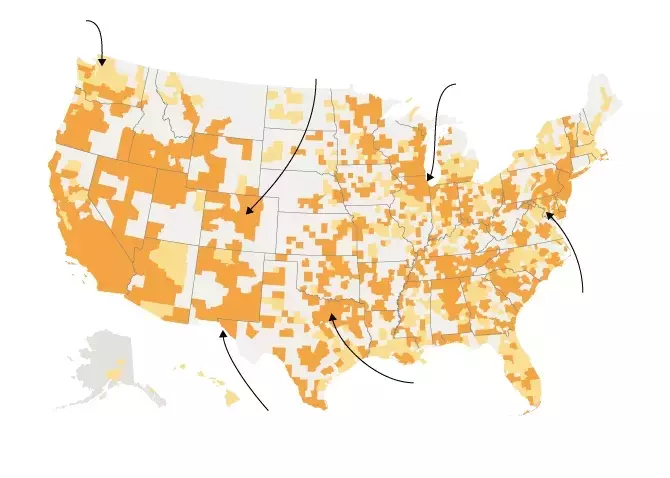
The newly released data from the Census Bureau highlights a universal decline in immigration rates across every metropolitan area in the United States. In the Texas border region of Laredo, for instance, international arrivals virtually ceased. Similarly, El Centro, a historic entry point into California via the desert, saw more people depart for other countries than arrive. Major cities were not immune; Denver and its surrounding areas witnessed a nearly 75% drop in net immigration, while the Chicago metropolitan area experienced a reduction of almost two-thirds. This pervasive slowdown has implications for economic and social landscapes nationwide.

Further detailed examination reveals that these changes extend beyond just immigration. The overall population growth, which encompasses international migration, internal relocations, births, and deaths, either slowed down or became negative in approximately 75% of all counties. This means that only a quarter of U.S. counties saw an acceleration in their population growth. The most affected regions included densely populated urban counties and those along the border, which had previously been characterized by a surge in new residents.

The data presented visually through maps underscores the severity of this shift. Metropolitan areas depicted in darker shades of yellow signify a reduction of over 50% in net immigration, while lighter yellow indicates a decline of less than 50%. Notably, some areas, primarily those not classified as metropolitan or micropolitan statistical areas, or those with historically low immigration, appear in grey, suggesting a pre-existing trend or irrelevance to the current analysis. This comprehensive overview provides a clear picture of the diminishing flow of international migrants into various parts of the U.S.

In essence, the recent Census Bureau report paints a clear picture of shifting demographic trends within the United States. It underscores a significant and widespread decrease in net international migration across all metropolitan areas, with particularly sharp declines observed in border regions and major urban centers. This deceleration in immigration has, in turn, led to a broader slowdown or reversal in overall population growth for the majority of U.S. counties, signaling a notable demographic change compared to previous years.

More Articles
News
Irish Village Embarks on Digital Detox for Children
The coastal community of Greystones, Ireland, has initiated a pioneering effort to curb smartphone use among pre-teen children. This community-wide initiative, backed by parents, educators, and local businesses, aims to mitigate the negative impacts of early smartphone exposure. The goal is not to eliminate technology entirely but to foster a healthier relationship with digital devices, encouraging children to engage more with their physical surroundings and each other.
By Katty KayMar 25, 2026
News
Meta Lays Off 700 Employees Amid AI Shift While Top Executives Receive Substantial Compensation
Meta recently announced the layoff of approximately 700 employees, primarily from its Reality Labs division, recruitment, sales, and Facebook. This decision reflects the company's strategic pivot towards artificial intelligence. Simultaneously, Meta unveiled a new stock program for six senior executives, potentially boosting their compensation by hundreds of millions of dollars each over the next five years. This stark contrast highlights the significant impact of AI on the tech industry, as Meta's CEO, Mark Zuckerberg, aims to develop 'superintelligence' while restructuring the company's workforce and prioritizing AI talent.
By Michele NorrisMar 25, 2026
News
Judge Hellerstein: The 92-Year-Old Jurist Taking on High-Profile Cases
At 92, Judge Alvin Hellerstein, a respected figure in the U.S. District Court for the Southern District of New York, continues to preside over complex legal battles, including the challenging case of former Venezuelan leader Nicolás Maduro. Despite his age, Hellerstein is known for his sharp intellect, methodical approach, and unwavering commitment to legal principles, as demonstrated in his previous rulings and high-profile cases.
By Katty KayMar 25, 2026
News
Leadership Void Impacts CDC Operations and Morale
The Centers for Disease Control and Prevention (CDC) is experiencing significant challenges due to a prolonged leadership vacuum, staff reductions, and shifting policy priorities. This has led to low morale among employees and concerns about the agency's ability to effectively carry out its public health mission, despite recent positive changes like restored funding and a new acting director. The article explores the internal struggles and external perceptions affecting the CDC's critical functions.
By Michele NorrisMar 25, 2026
News
Maternal COVID-19 Vaccination Safeguards Infants, Large Study Confirms
A significant study involving over 140,000 infants reinforces that COVID-19 vaccination during pregnancy effectively transfers protective antibodies to newborns. This immunity offers substantial protection against severe COVID-19 in the babies' first few months of life, a critical period when they are too young for direct vaccination. The research also dispels concerns about increased risks of other infections in vaccinated infants.
By Ann CurryMar 25, 2026